
ePortfolio Artifacts
A. COLLECT
An ePortfolio is a digital collection of materials that provides authentic evidence of your experiences and learning. These materials, often called ARTIFACTS, can exist in many different formats such as electronic documents (Word, Excel, PowerPoint presentation, Web pages), multimedia files (video, audio, graphic, image, photo, art, music) and links (blogs, social media, other websites).
How do you decide what artifacts to COLLECT? Foliotek enables you to collect and store artifacts and use them to create multiple portfolios.
1. Collect evidence of your learning in both formal (courses) and informal settings (service learning projects, co-curricular activities, work experiences, etc.)
2. Collect artifacts that document your progress, such as …
a. An early draft, feedback from peers or instructor, and a final draft
b. Work done in Tier 1, Tier 2, and Tier 3 courses that addresses one or more Core Curriculum Objectives*
c. An example of work that reveals how "I used to think" and another example that shows "Now I think" related to a Core Curriculum Objective*
d. Early work that reveals a misconception or inaccurate work and later work that shows improved understanding, knowledge or skill
3. Collect artifacts that showcase your best work, special abilities, and extraordinary experiences. Some transfer programs and professional schools require on- ground rather than online laboratory work, so consider collecting videos that provide evidence of your lab skills.
4. Carefully document the context, assignment, question or prompt used to create the artifact. Include the date, course, instructor, location or other pertinent information.
B. SELECT
How do you SELECT artifacts for inclusion in a portfolio? ePortfolios are especially valuable for you as a community college student because you will be "transporting" your learning to other colleges or universities. You can provide a link to your ePortfolio in an application for advanced academic work, scholarships and employment.
To decide which artifacts to include in a portfolio, consider the type and purpose of the portfolio.
- Project Portfolio - The instructor may give you specific requirements and identify the number and types of artifacts to include in the portfolio. However, you may want to collect and store more artifacts in your FILES than you place in your portfolio. You may be able to refine and expand this project portfolio for a later integrative assignment. You could create a works cited file or annotated bibliography to document your resources, transcripts or videos of interviews you conduct while doing research for the project, a video taken when you present the project, feedback you receive on the project (text, audio or video), and other artifacts to document the scope of your work and your learning.
- Course Portfolio – EDUC 1300 students are asked to build a course portfolio using the pre-built "Lifelong Learner" portfolio.Each page contains prompts to guide the creation of the portfolio using artifacts developed in EDUC 1300 andother learning environments. Remove these prompts before sharing the portfolio with others. You may continue to use and update this portfolio for other purposes.
Instructors may ask you to create a specific portfolio for a particular class and identify the number and types of artifacts to include in the portfolio. Likely, you will asked to select artifacts that address one or more student learning outcomes (SLO) for the course. Consider creating artifacts using a variety of media. This will create interest in your portfolio, give you opportunities to document your learning using new technologies, and provide artifacts that you can use later to address broader Core Curriculum Objectives.*
- Core Curriculum Portfolio – Select artifacts that showcase the knowledge and skills you acquire in Tier 1, Tier 2 and Tier 3 for each of the Core Curriculum Objectives.* You will add content to this portfolio each semester you are enrolled in the DCCCD. Use the pre-built "DCCCD Core Portfolio" TYPE to create this portfolio. Prompts are written on each portfolio page to guide your thinking and learning. Be sure to remove these prompts before you share the portfolio. Later, you will be asked to post this portfolio for use in the assessment of the DCCCD Core Curriculum by the Texas Higher Education Coordinating Board (THECB) and the Southern Association of Colleges and Schools (SACS). Although you may share or publish your DCCCD Core Portfolio, it will not be made public when you post it for assessment purposes.
- You may create any number of other portfolios to document your learning, to seek admission to professional programs, to apply for jobs and scholarships, etc. Foliotek provides custom portfolio design features, the ability to create custom or pre-built portfolios, and tools that allow you to copy your existing portfolio(s) to modify for other uses. You will be notified by Foliotek when your three year account is set to expire and given the opportunity to purchase additional access at an affordable price. You can also export any portfolio to a zip file.
C. REFLECT
Why REFLECT on your learning experiences? A reflection on your learning experience (class activity, assignment, project, work experience, etc) gives you an opportunity to think about what you have learned, examine the procedures used while learning, and make connections to other things you've learned. Recent research reveals that potential employers find that reflections provide more compelling evidence of learning than course work, grades or other experiences.
Create reflections for each artifact (or collection of artifacts) you select for inclusion in a portfolio. Reflections are frequently a written activity, but can articulate your learning in less traditional ways such as through videos, digital images and audio recordings. Connect reflections to specific artifacts to give meaning and value to artifacts and demonstrate your learning.
Consider placing the Reflection (text, video, image, recording, etc.) on the appropriate portfolio page and embedding a link to the artifact(s) that is the evidence of your learning. An alternative would be to provide links to both the artifact and the reflection on the same portfolio page.
D. CONNECT
How will you benefit when you CONNECT your thinking and learning? Creating ePortfolios requires that you make connections between …Your portfolio provides an opportunity for you to move BEYOND work "on paper" to work that is organized, searchable and transportable. This dynamic nature of ePortfolios allows you to collect and store evidence of your learning over time. The process of selecting and connecting artifacts from multiple learning experiences in a variety of contexts and creating reflections foster your abilities to apply and integrate learning.
- Prior knowledge and newly acquired knowledge
- Misconceptions and improved understanding
- Early and later drafts
- Work done in Tier 1, Tier 2 and Tier 3
- Artifacts and reflections
- Artifacts, reflections and course outcomes and/or Core Curriculum Objectives*
- Artifacts created in different contexts
- Formal learning and informal learning
EDUC Learning Framework Course & ePortfolio Pilot Class
Dallas County Community College District
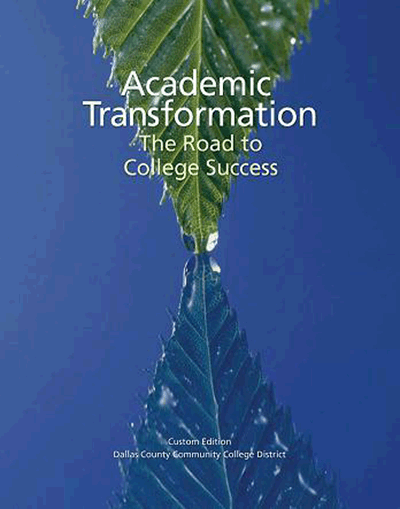 3 hrs. of transferable credit Required of all students with less than 12 hours of college credit*
Get more out of your education with this dynamic course! Discover your strengths and weaknesses, set goals, practice critical academic and lifelong learning skills, and develop effective academic behaviors for college success. You will acquire the tools to accomplish your goals academically, personally, and in your career. The course includes a balance between theoretical underpinnings and the experiential application of learning strategies. The focus of the course is on (a) research and theory in the psychology of learning, cognition, and motivation; (b) factors that impact learning; and (c) application of learning strategies. Coordinating Board Academic Approval Number 4203015125
Please don't confuse the Learning Framework course with a pep talk or a simple study skills course. It's not that. This course is a combination owner's manual and tool box for your education. You get on-the-job training in being a more successful student beginning the first day of class. You'll gain valuable knowledge and skills through guided learning activities and practical exercises. Then you roll up your sleeves and test the ideas yourself in other classes and life experiences.
The Learning Framework Course will help you:
|
|
|
|
|
|
|
|
|
|
|
|
|
|
|
Assessment Portfolio Pilot Project
| COLLEGE | Fall 2010 foliotek pilot EDUC 1300 Faculty |
| BHC | Amy Monroy |
| CVC | Edna White |
| ECC | Elke Hardt |
| EFC | Phillip Ortiz |
| MVC | Daven Salmi |
| NLC | Angelo Alcala |
| RLC | Cody Arvidson (on ground) |
| RLC/LCET | Cody Arvidson (online) |
